
4 Allegheny National Forest Waterfalls You Must Visit

When most people think of great waterfall destinations in Pennsylvania, places like Ricketts Glen State Park, Delaware Water Gap NRA, or Ohiopyle State Park usually come to mind first.
The Allegheny National Forest, on the other hand, is better known for remote hiking trails, backpacking, scenic drives, camping, and some of the best forest solitude in the state.
Waterfalls aren’t the main attraction here… but that’s exactly what makes these few waterfalls so special.
Scattered throughout more than half a million acres of forest, you’ll find a handful of waterfalls that feel wonderfully wild and off the beaten path. Some are easy to access. Others require long drives down rugged forest roads or muddy hikes through remote terrain.
That’s part of the adventure.
I’ve visited all four of these waterfalls, and while each offers something different, they all share one thing in common: they’re places I want to go back to.
If you’re planning a trip to the ANF, these are four waterfalls I think are absolutely worth adding to your itinerary.
Quick Comparison of Allegheny National Forest Waterfalls
Best overall: Hector Falls
Easiest to reach: Bent Run Falls
Most dramatic after rain: Logan Falls
Most remote adventure: Pigeon Run Falls
Hector Falls
If I could only recommend one waterfall in the Allegheny National Forest, Hector Falls would probably be it.
That’s not because it’s the tallest or most powerful, but because it’s one of the most unique waterfalls I’ve seen anywhere.
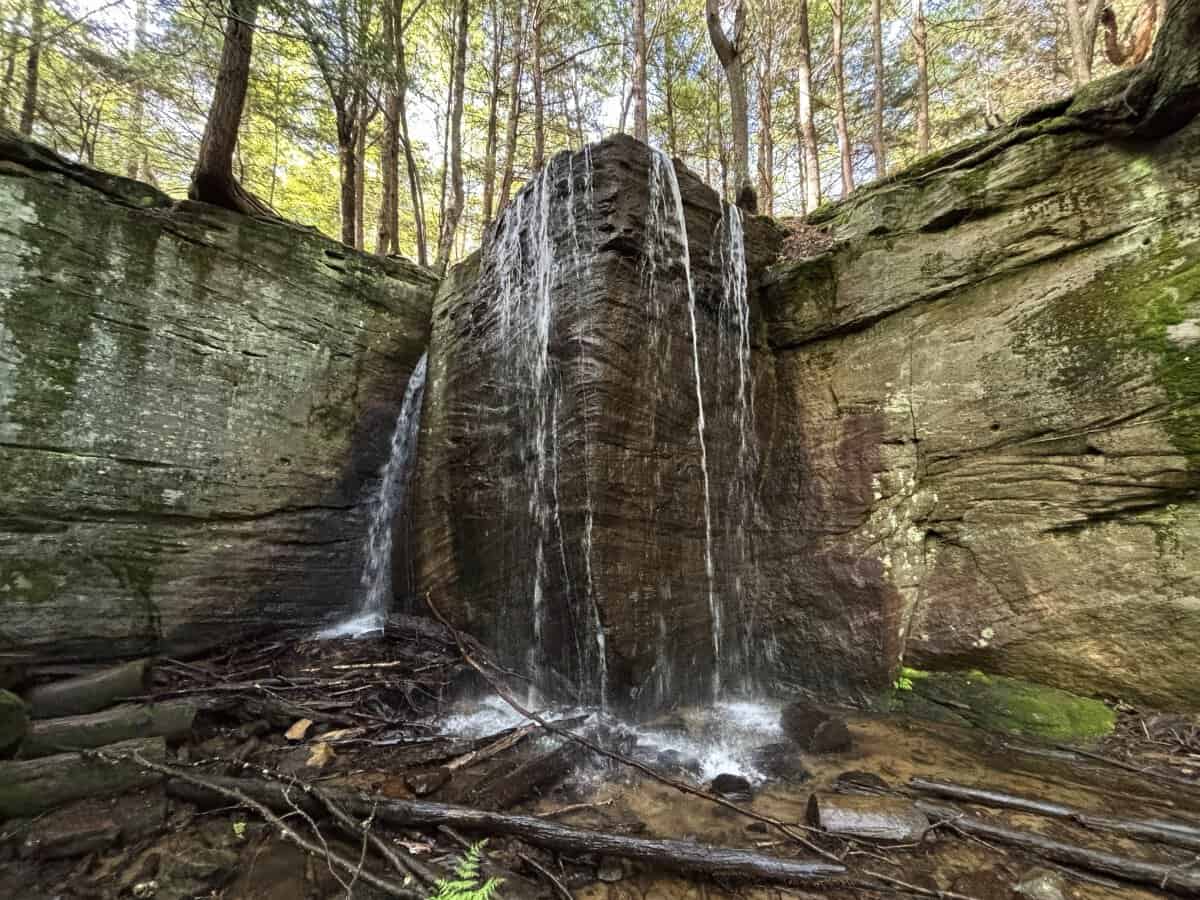
Hector Falls drops roughly 22 feet over a massive sandstone ledge and is surrounded by enormous moss-covered boulders that create incredible viewing angles and natural framing for photos.
What makes this waterfall especially memorable is the setting.
Instead of simply walking up to an open waterfall viewpoint, you get glimpses of the falls through narrow gaps between giant rocks right before the full scene finally opens up in front of you.
The trail begins on Forestry Road between Sheffield and Ludlow. From the parking area, it’s about a 1-mile hike to the falls, mostly along an old logging road before the trail dips into the woods for the final approach.
The hike itself isn’t extremely difficult, though the final stretch can be muddy.
One thing I’ve learned from multiple visits: water levels dramatically change the experience here.
During dry conditions, you may see only a narrow stream flowing over the cliff. After heavy rain, water often spills over two faces of the rock ledge, making the waterfall much more impressive.
If possible, I’d absolutely recommend visiting after recent rain.
One practical tip: BRING BUG SPRAY.
The base of the falls can get buggy during warmer months, especially when the air is still.
Why visit: Most unique waterfall in the ANF with incredible rock formations.
Bent Run Falls
Bent Run Waterfalls is the most conveniently located waterfall on this list to visit and makes an excellent stop if you’re already exploring the Kinzua Dam area.
In fact, it’s basically right across the road.
This waterfall system feels different from the others because it isn’t just one waterfall.
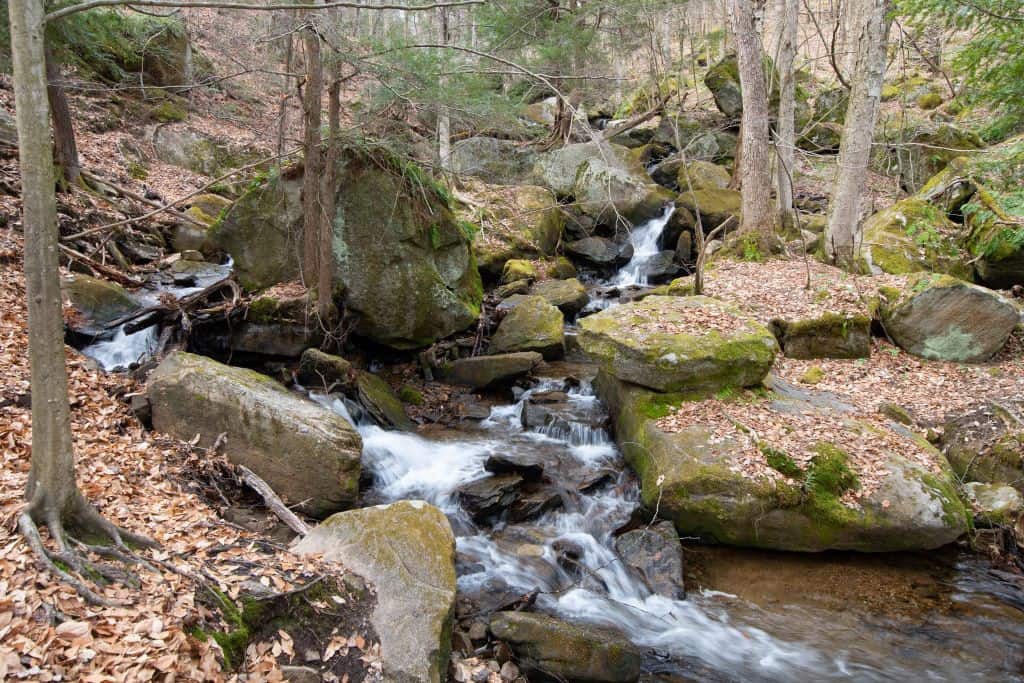
Instead, Bent Run consists of multiple cascades and rock slides spread throughout a steep ravine, with water flowing over layered rock formations in several directions.
The trail is short but steep.
You’ll climb roughly 300 feet over a relatively short distance, and there are multiple branching side trails that allow you to explore different sections of the falls.
Because of the steep terrain, roots, and loose footing, watch your step.
This is especially important if conditions are wet.
Bent Run is enjoyable year-round, but like most waterfalls in the ANF, it really shines after rain.
During dry summer stretches, flow can slow considerably, creating calmer pools and smaller cascades that are still beautiful in a different way.
If you want a quick waterfall stop without committing to a long hike or rugged forest roads, this is probably your best option.
Why visit: Convenient access near Kinzua.
The waters at Bent Run Falls are perfect for appreciating its beauty up close. During dry summers the waters tend to slow, creating a calming atmosphere that’s ideal for taking pictures or simply relaxing.
During heavy rains, the falls become much more powerful and create an impressive sight! So don’t miss out on exploring Bent Run Falls if you are near the Kinzua Dam.
Logan Falls
Logan Falls may be the most dramatic waterfall on this list when water levels are high.
It’s also surprisingly easy to reach, even though the trail is steep.
To visit Logan Falls, drive down Coal Bed Run Road to a small parking area that fits roughly five vehicles.
From there, an obvious trail descends about 0.25 miles down a steep hillside to the falls.
The short distance makes this one feel very approachable, but don’t underestimate the steep descent because you’ll have to go right back up on the return hike.
Once you reach the waterfall, you’ll find water that rushes over large boulders and rock shelves, creating powerful cascades and foamy whitewater.

The surrounding rock formations are equally impressive and help give Logan Falls a dramatic feel.
This is another waterfall where recent rainfall matters a lot.
During dry stretches, the flow becomes calmer and easier to explore around.
After heavy rain, Logan Falls transforms into a much more powerful and energetic waterfall.
Why visit: Possibly the most powerful waterfall after heavy rain.
Pigeon Run Falls
Pigeon Run Falls is the most remote waterfall on this list, and getting there is half the adventure.
The hike itself is fairly easy.
The drive is not.
To reach the trailhead, start in Marienville and head out via East Spruce Street past the gas station.
From there, you’ll spend nearly 9 miles navigating dirt and gravel forest roads filled with potholes, mud, and rough sections.
In wet conditions, this drive can become challenging.
One important warning: if you’re approaching from the east, GPS may try to route you through roads in the state game lands.
Do not rely on that route. Some of those roads are gated or inaccessible to the public.
The most reliable access is via Marienville from the west.
Once you reach the small clearing near the bridge over Spring Creek, stop there.
Trust me.
The road gets significantly worse beyond that point. We learned that the hard way. You might not make it if you don’t have 4WD and high clearance. I was wishing I was in my Jeep on that part of the road…
From the trailhead, it’s an easy 1-mile hike along bridle trails to the falls.
The hiking itself is through a pleasant and straightforward forest setting.

Once you reach Pigeon Run Falls, you’ll find water cascading over layered boulders and smaller rock shelves in a peaceful forest setting.
It’s not the tallest of the waterfalls here, but because of the effort required to reach it, this waterfall feels especially rewarding.
It also tends to be the least crowded.
Cell service is essentially nonexistent in this area, so be prepared and don’t count on calling for help if you get stuck.
Why visit: Most remote and adventurous waterfall experience.
Tips for Visiting ANF Waterfalls
A few things I’ve learned while chasing waterfalls in the Allegheny National Forest:
- Waterfalls are best after rain
- Forest roads can become muddy or impassable
- GPS is not always reliable in remote areas
- Cell service is often limited or nonexistent
- Bring bug spray in warmer months
- Wear shoes with good traction
Many of these waterfalls feel far more remote than their mileage suggests.
A little preparation goes a long way.
FAQs: Allegheny National Forest Waterfalls
What park has the most waterfalls in Pennsylvania?
Ricketts Glen State Park is widely considered Pennsylvania’s premier waterfall destination, with 22 named waterfalls along its famous Falls Trail.
What is the longest trail in the Allegheny National Forest?
The North Country National Scenic Trail is the longest trail in the ANF, with roughly 96 miles passing through the forest.
Where is the biggest waterfall in PA?
Raymondskill Falls in the Delaware Water Gap National Recreation Area on the eastern border of the state is the tallest waterfall in Pennsylvania at approximately 178 feet.

The waterfalls of the Allegheny National Forest may not be as famous as waterfalls elsewhere in Pennsylvania, but that’s part of their charm. They feel wild, quiet, and wonderfully undiscovered.
Explore the giant sandstone boulders at Hector Falls and the rugged remoteness of Pigeon Run Falls, each a different adventure.
Whether you’re camping in the national forest, staying near Chapman State Park, or spending a weekend in a nearby cabin, these waterfalls make excellent additions to any ANF itinerary.
Bring your camera, prepare for a little adventure, and enjoy exploring some of the most underrated waterfalls in Pennsylvania.
